

Fifty-fifty
A late spring snapshot.

Spring 2025 will go down as a tale of two contrasting mini-seasons. The first half of spring cooked. The rains dried up as a consequence of a Sudden Stratospheric Warming event over Antarctica and with the drying came heat. South east Queensland experienced numerous heatwaves and with many of my new plants struggling, I had flashbacks to 2019, a spring of extreme drought and bushfires. A few fires did erupt in the local area, but thankfully none got out of control.
By late October, the SSW had waned and three of our four weather drivers – the Madden Julian Oscillation (MJO), the Indian Ocean Dipole (IOD) and Southern Oscillation Index (SOI) – were all favouring a return to wetter conditions. In other words, classic whiplash weather, the kind that crinks your neck and confuses plants. I’ve lost a couple simply because of this whiplash effect. Ov er the years I’ve been gardening I’ve seen many plants die when extreme wet weather replaces dry more often than I’ve seen the reverse. This is especially true of species prone to root rot. They tough it out in the dry then become very prone to fungal pathogens when it suddenly flips to wet.
All I can say is welcome to gardening in a climate era when the booms and the busts are becoming more and more amplified. The term “average” is becoming less and less relevant and the Primacy-Recency Effect means that we tend to forget what older climate eras were once like. The new normal is a weather rollercoaster. Gardeners can try to plan ahead for the peaks and dips, but in my experience, the best you can do is hold on tight and try not to regurgitate your lunch.
That said, every season has its winners and losers. On the winning side of the ledger this season has been the kind of plants you’d expect. Possibly the best performers in my garden (with its very low nutrient, free draining soil) continues to be native shrubs like grevilleas and banksias. But in heavier, richer soils this might not be the case. You’ll need to experiment and be prepared to potentially burn some cash on plants to learn what works for you. Salvias of all kids are also standouts for me. Thankfully, this genus is incredibly diverse, which means while all species share common traits like square stems and lipped flowers, there are lots of options for flower colour and form. Some salvias are tall shrubs with big, sassy flowers, others are demure. They are simply one of the best non-native plant groups for Australian conditions.
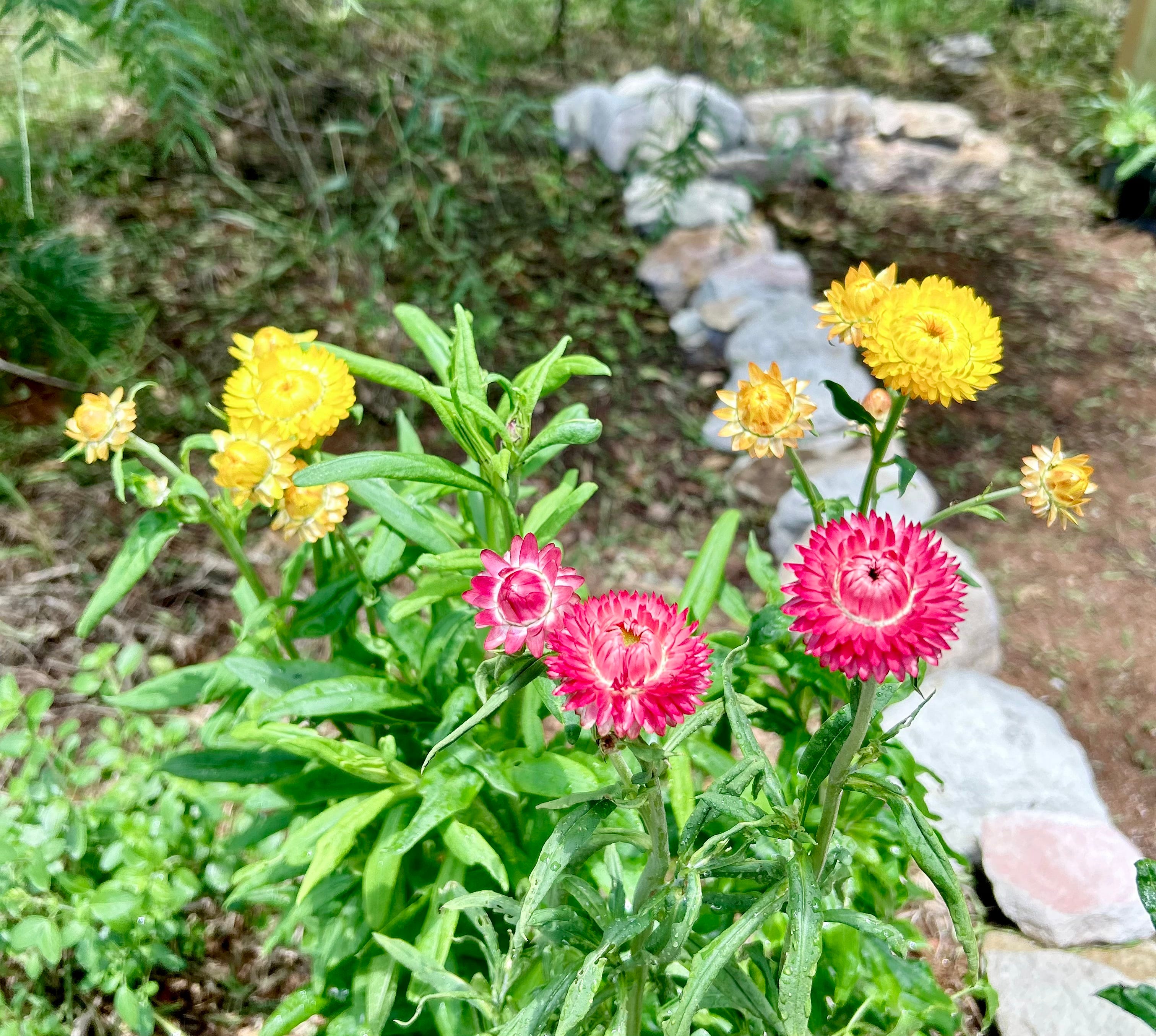
On the loser side of the ledger are a few surprises. Native perennial and annual flowers, like isotomas and strawflowers, did very poorly in the dry and still need supplemental water now that it’s a bit wetter. They’re pretty plants but I expected better. A bigger surprise was the loss of some agapanthus plants when the rain returned. Mind you, these weren’t the regular aggies you see everywhere around the Toowoomba area, but a herbaceous cultivar called ‘Purple Cloud’. It’s a stunning plant that sports dark purple flowers atop a five or six foot tall stem but sadly, it decided to drop dead from the whiplash effect. One little clump remains. I’m hoping it survives, because dividing aggies is easier than falling off a log.
On a closing note, it’s worth saying that even though I’ve written this dispatch in binary terms – fifty/fifty, winners/losers, alive/dead – binaries aren’t really a thing, are they, in gardening or general life. Spectrums and grey areas are the rule. Many plants are neither thriving nor dying. Some are piddling along cheerfully, without setting any pace records. Others are in a state of indecision. Some are going absolute gangbusters.
The keys to success are twofold, I think. First, the ability to live with doubt and uncertainty. The Romantic era poet John Keats called this quality “negative capability” and contrasted it to “irritable reaching”, the need for certainty. He applied it mostly to creative endeavours but I think it’s applicable to everyone. The second key is diversity. In this quality resides resilience, and with plenty more climate change locked in for the decades ahead (thanks to our corporate overlords and their greed), resilience is something we’re all going to need in spades.
I have transplanted that Aggie into bigger clumps and I spotted a flower bud this morning. Yay!! All the salvias are powering on too.
I’ve found that in our soil at Boodua, all of the eremophilas do so well. The only time I’ve had any problem with agapanthus was quite some years ago when we had a really bad black frost one Winter. They turned to piles of jelly overnight 😳😕